The publication of Earl Spencer’s new memoir has reopened painful questions about Princess Diana’s final days, with one royal commentator arguing that Diana herself might have been deeply upset by her brother’s decision to reveal an alleged remark by King Charles.
In an opinion piece, Ingrid Seward, editor of Majesty Magazine, said she believed Diana would have been “horrified” to see the private exchange made public. Spencer’s account concerns a tense conversation with the then-Prince Charles shortly after Diana’s death in 1997, during an argument over the role of her young sons in the funeral procession. (The Sun)
‘Diana would be horrified’


Seward said that when she last met Diana, around six weeks before her death, the Princess was adamant that she and Charles still loved each other.
She argued that this would make the publication of Spencer’s account particularly painful for Diana, especially because the alleged remark could be interpreted as showing hostility or malice towards her.
At the same time, Seward stressed that she did not believe the comment was necessarily intended in the way it might appear today.
Her comments come as Spencer’s memoir, Swan Song: Diana, My Sister, prepares to bring his personal recollections of Diana’s life and death into the public domain.
The dispute over Diana’s funeral


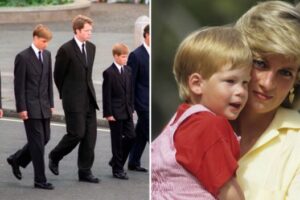
One of the most sensitive episodes in the memoir concerns the decision to have Princes William and Harry walk behind their mother’s coffin.
William was 15 and Harry was 12 when Diana died in August 1997.
According to Spencer’s account, he was told by a senior Palace aide that the boys would take part in the funeral procession. He objected, saying that Diana would not have wanted her young sons to face such a public ordeal.
Spencer says Charles called him shortly afterwards and the conversation quickly became heated.
In his memoir, Spencer claims the then-Prince of Wales referred to his own experience of walking behind the coffin of Lord Mountbatten in 1979. Spencer points out that Charles had been 30 at the time, while William and Harry were still children.
Spencer says the conversation then escalated before Charles allegedly made the remark that has now attracted widespread attention: “Rest assured, we’ll forget her soon enough.”
Spencer recalls being stunned by what he heard and says he ended the call after telling Charles: “I can’t believe you just said that.”
The account remains Spencer’s recollection of a private conversation nearly three decades ago and has not been independently established. Buckingham Palace has responded by highlighting the possible effects of grief on memory and judgment. (People.com)
A long-running divide between the Spencers and the Royal Family

Seward also points to the difficult relationship between the Spencer family and the Royal Family in the aftermath of Diana’s death.
The Spencers have long been closely connected to the British aristocracy and the monarchy. Charles Spencer, Diana’s younger brother, was particularly prominent in the aftermath of her death, delivering the emotional eulogy at Westminster Abbey in September 1997.
In that speech, he pledged that Diana’s “blood family” would do everything possible to protect William and Harry, declaring that their lives should not be completely defined by duty and tradition.
His words became one of the defining moments of Diana’s funeral and reflected the complicated feelings surrounding the Royal Family and the Spencer family at the time.
Spencer’s decision to tell Diana’s story

Swan Song: Diana, My Sister is due to be published in the UK on September 22, 2026, nearly 30 years after Diana’s death. The book is being published internationally and will be translated into 12 languages. (global.penguinrandomhouse.com)
It is Spencer’s first book devoted at length to his sister and covers their childhood together, Diana’s marriage to Charles, her life as a member of the Royal Family and the events surrounding her death.
Spencer has said that he decided to write the memoir after receiving repeated requests for interviews as the 30th anniversary of Diana’s death approached.
He said he wanted to put his own memories and thoughts on record rather than continue seeing accounts of Diana that, in his view, contained inaccuracies that had gradually become accepted as fact.
His stated intention is to present Diana from her brother’s perspective and to portray her as a complex, loving and charismatic woman who made a lasting impact despite her life ending at just 36. (The Guardian)
Why the memoir has reopened old wounds

For Seward, the most difficult issue is not simply what Spencer remembers, but what revealing those memories may mean nearly three decades later.
Diana’s relationship with Charles had already been marked by a highly publicised marital breakdown before their divorce in 1996. Her death the following year transformed the family conflict into a much larger national and international tragedy.
The disagreement over William and Harry’s role in the funeral procession became one of the most emotionally charged decisions surrounding Diana’s funeral. Both brothers have since spoken about how difficult the experience was.
Harry later wrote in Spare that his uncle had objected strongly to the idea of the boys walking behind their mother’s coffin, describing the proposal as “barbaric”. William has also recalled the procession as one of the hardest experiences of his life.
A personal account — and a disputed memory
Seward accepts that Spencer has a right to tell his side of the story, but she argues that his interpretation is inevitably shaped by his own relationship with Diana and the events that followed her death.
She also criticised his decision to reveal such a sensitive allegation, saying she did not believe he had been sufficiently careful about what he chose to make public.
Spencer, however, has presented the memoir as an attempt to preserve his own memories of Diana and correct what he regards as misconceptions about her.
That leaves two very different perspectives at the centre of the controversy: Spencer’s personal recollection of an intensely emotional period in 1997, and the Palace’s suggestion that grief can influence how such events are remembered years later.
Nearly 30 years on, the dispute has once again placed Diana, Charles and the painful aftermath of her death at the centre of a royal controversy. (People.com)