Bullet Train Review: Brad Pitt’s Charisma Keeps a Wild Assassin Thriller on Track — Until the Story Becomes Too Crowded

Brad Pitt may be on charismatic form, but this ultra-violent action thriller takes too many side routes and pit stops to be a satisfying tripCredit: Alamy
Brad Pitt has enough movie-star charm to make almost any journey entertaining, but even he struggles to keep Bullet Train from becoming overwhelmed by its own increasingly complicated chaos.
Directed by Deadpool 2 filmmaker David Leitch and adapted from the Japanese novel Maria Beetle, the 126-minute action thriller places Pitt aboard a high-speed train bound for Kyoto — then surrounds him with assassins, competing agendas and a seemingly simple briefcase that everybody wants.
Pitt plays Ladybug, an introspective assassin who would rather avoid unnecessary confrontation after developing a new outlook on life.
His assignment sounds straightforward: board the train, retrieve a briefcase and get off.
Naturally, almost nothing goes according to plan.
Brad Pitt is having enormous fun

The film centres on Pitt’s introspective, gun-avoidant assassin Ladybug, who is on a mission to collect a briefcase on a bullet train heading to KyotoCredit: Alamy
Ladybug soon discovers that several other dangerous passengers have their own reasons for being aboard, and their missions begin colliding in increasingly ridiculous ways.
Pitt is easily one of the film’s biggest strengths.
Rather than playing Ladybug as a conventional action hero, he leans into the character’s weary, playful personality. He can handle the physical comedy and elaborate action while still delivering the boyish charisma familiar from films such as Ocean’s Eleven, Snatch and Inglourious Basterds.
Watching a reluctant assassin attempt to talk his way through situations that clearly aren’t going to be solved peacefully provides some of the movie’s best comedy.
Unfortunately, the story surrounding him rarely shows the same restraint.
A train packed with eccentric assassins

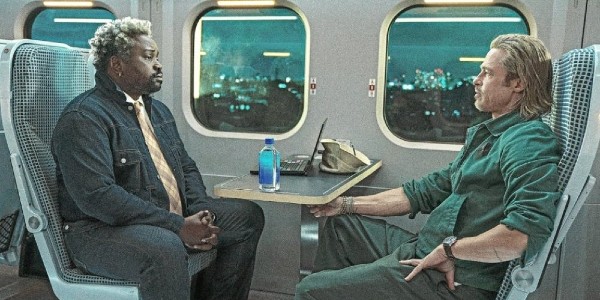
Aaron Taylor-Johnson and Brian Tyree Henry provide another entertaining pairing as Tangerine and Lemon, two stylish East London killers with a relationship that often feels closer to argumentative brothers than professional assassins.
Lemon’s obsession with Thomas the Tank Engine becomes one of the film’s strangest recurring jokes. He uses characters from the children’s series as a way of categorizing personalities and identifying people he considers dangerous.
It is ridiculous, but that is entirely the point.
Joey King plays Prince, a manipulative young assassin whose innocent appearance conceals very different intentions. Yet despite being the film’s most prominent female character, the role feels comparatively limited.
The eccentric collection of criminals inevitably brings to mind the ensemble crime worlds associated with Pulp Fiction and Lock, Stock and Two Smoking Barrels.
But those comparisons also expose Bullet Train’s biggest weakness.
Too many detours slow down the ride
Quentin Tarantino and early Guy Ritchie films could juggle multiple characters, timelines and intersecting plots while gradually bringing seemingly unrelated pieces together.
Bullet Train wants to perform a similar trick.
Instead, it keeps introducing more characters, more backstories, more flashbacks and more explanations.
The result becomes unnecessarily complicated.
Rather than allowing the central train journey to build momentum, the film repeatedly interrupts itself to explain another passenger or reveal another connection.
That structure eventually begins working against the very thing a movie called Bullet Train should possess: speed.
There are amusing individual sequences, but the accumulation of subplots makes the 126-minute running time feel heavier than necessary.
David Leitch still knows how to stage action
Where the movie unquestionably delivers is in its physical set pieces.
Leitch brings his action experience to the confined train environment, using unusual camera angles, slow motion and unexpected objects to make confrontations visually playful.
The fights rarely settle for straightforward choreography. Everyday objects can suddenly become part of the action, while the exaggerated style pushes many encounters toward cartoon territory.
That tone suits the film’s colorful characters and allows Pitt to move naturally between comedy and action.
The problem is that stylish fights cannot completely compensate for a narrative that keeps adding another layer whenever it might benefit from becoming simpler.
A chaotic ride that needed fewer stops
TRAILER BELOW
There is a leaner and more satisfying action comedy somewhere inside Bullet Train.
Pitt is charismatic, Taylor-Johnson and Henry make an entertaining duo, and Leitch gives the action enough visual personality to prevent the movie from becoming dull.
But the film seems determined to use every idea it has.
Flashbacks compete with new characters, side stories interrupt the main journey and twists continue arriving until the plot begins to feel less intricate than overcrowded.
For viewers willing to embrace its deliberately exaggerated style, there is still fun to be had aboard this train. Pitt, in particular, appears completely comfortable at the center of the madness.
Yet charisma can only carry the journey so far.
Bullet Train races through a mountain of colorful ideas, but by the time it reaches its destination, the movie has taken so many unnecessary detours that even Brad Pitt cannot make the entire trip feel worthwhile.
★★☆☆☆