PBS announced last summer that it would be showing “World on Fire,” so it can’t be accused of capitalizing on current events. Congratulate it instead on its good timing: a sweeping drama about people’s responses to the approach of a potentially world-destroying virus, in this case Nazism.
“World on Fire,” a “Masterpiece” series (beginning Sunday night) from the BBC, was written by Peter Bowker, who’s best known for the 2009 Iraq War mini-series “Occupation.” His talent here is for orchestration more than for texture — the seven-episode series (six were available for review) is a page-turner of a show, a big canvas filled with small, interwoven stories in the style of Herman Wouk. There’s some cardboard in the construction, but the narrative tug is strong. A solid success in Britain last year at close to 6 million viewers an episode, it’s been renewed for a second season.
The action stretches across Europe, from Warsaw to Berlin, Paris, Dunkirk and Manchester, as the German blitzkrieg hammers across Poland and Belgium beginning in 1939. There are frequent depictions of battle, sometimes in milieus we haven’t often seen, like the gallant and doomed Polish defense of the Danzig post office.
Despite its apocalyptic title, though, and some time spent on the evacuation at Dunkirk, “World on Fire” isn’t about big events. To paraphrase “Casablanca,” it’s about the problems of little people and how those problems amount to more than a hill of beans. Transformation can come even for those who are just muddling through and doing their bit.
To that purpose, Bowker manages to have his everyday characters bump into each other here and there around the continent without setting off too many implausibility alarms. Lois (Julia Brown), who sings for the British troops, has a brother, Tom (Ewan Mitchell), who is wounded at Dunkirk and rescued by the gay American doctor Webster (Brian J. Smith), whose lover Albert (Parker Sawyers) is in a Paris jazz band with Eddie (Ansu Kabia), who needs to get back to Manchester to be with his wife, Connie (Yrsa Daley-Ward), who plays piano for Lois. That sort of thing.

The themes and outlines of “World on Fire” are firmly middle of the road — you imagine a good share of the audience watching it over tea and a biscuit — but Bowker has worked conscientiously to make the manifold subplots a little different from the norm for World War II dramas. Notably, none of the major characters are Jewish; the show’s principals deal with other dangers: being a Polish Catholic, a German epileptic, a British pacifist or, in a deadly trifecta, a black, gay jazz musician.
Bowker is also notably hard on his men, who are generally a whiny, callow bunch, at least until they’re toughened up by the rigors of war. The primary male character, Harry (Jonah Hauer-King), a wealthy young Briton posted to Warsaw, marries a Polish woman while also knocking up Lois back in Manchester; escaping into the army, he is made a lieutenant and promptly freezes up in battle. He’s useless as either an officer or a gentleman.
The women, meanwhile, are uniformly tough: Lois, given an appealing doughtiness by Brown, quickly sets aside the wishy-washy Harry; Kasia (Zofia Wichlacz), Harry’s wife, joins the Polish resistance; Nancy (Helen Hunt), an American radio journalist in Berlin, is an Edward Murrow stand-in, trying to get out the truth despite the censor sitting outside her booth.
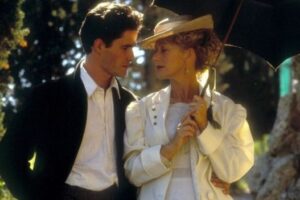
Strongest of all is Harry’s mother, Robina, a thorough prig and a fan of the British fascist Oswald Mosley, who begins to soften when she suddenly has to take care of Kasia’s young refugee brother. (Harry dumps his schoolboy brother-in-law on her before heading back to the continent.) And the best thing about the show is the great Lesley Manville’s performance as Robina, a believable and craftily comic portrayal of a woman who reluctantly lets down her guard in response to the war — though she’s farthest from the front, the changes she undergoes are as profound as anyone else’s. She’s Bowker’s proof that in a world on fire, no one escapes the flames.
An earlier version of this review misidentified the year in which German forces invaded Belgium during World War II. It was 1940, not 1939.
Mike Hale is a television critic. He also writes about online video, film and media. He came to The Times in 1995 and worked as an editor in Sports, Arts & Leisure and Weekend Arts before becoming a critic in 2009.
A version of this article appears in print on April 4, 2020, Section