When does pretty pretty become chic? When it stops being real.
By recreating the former glory of Cephallonia, an idyllic Greek island, decimated by earthquake in the Fifties, the moviemakers have invested in a beauty that looks too good to be true. The actors speak English with an accent, which means Italians, Germans and the native population can communicate in what to them is a foreign language. Call it cinematic licence.
Louis de Bernieres’s novel was last year’s literary sensation. Readers talk of it as they would a lover. Shawn Slovo was given responsibility to pare the book down to screen time proportions. Much has been lost, even more simplified. Will such changes be forgiven so soon after the publication of a work of fiction that moved people to tears?
Pelagia, the doctor’s daughter, is betrothed to Mandras, a handsome fisherman, who goes off to fight the Germans on the Albanian border. Meanwhile, the Italians occupy the island and Captain Corelli is billeted at the doctor’s house.
She is serious and proud. He is fun-loving and musical. She worries about the war and treats him as an enemy.
“Is everything a joke to you?”
He doesn’t answer.
His interests are singing, eating and making love. He tells her, “I’ve never aimed a gun in my life,” as if that excuses the invasion of her homeland.
Things change between them, as you would imagine. Mandras comes back and joins the partisans. Mussolini surrenders. The Germans send reinforcements and order the Italians to hand over their weapons. A terrible battle ensues.
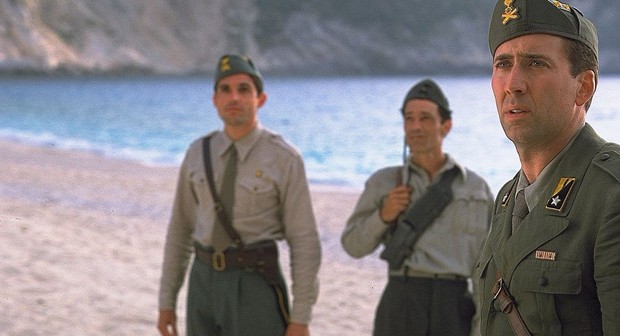
It is interesting to compare this with Mediterraneo, Gabriele Salvatores’ 1991 movie, based on a true story, of Italians stuck on an Aegean island during the war. John Madden’s production values are pure Hollywood. The secondary characters are pawns. Corelli’s squad acts as chorus. You don’t get to know them. Christian Bale, as Mandras, can do little but look hunky and anguished, despite trying hard with the accent.
In Mediterraneo, the light is harsher, the dust dustier and the characters fully drawn. Also, the humour evolves naturally from each and every one of them.
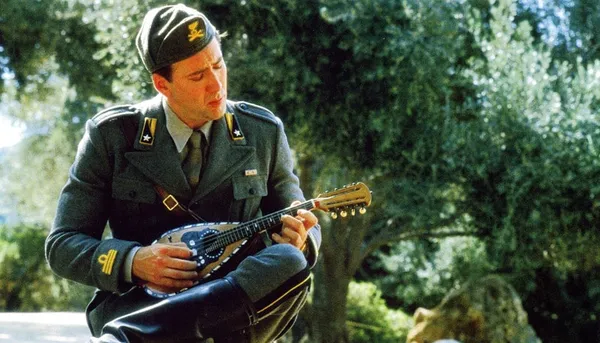
John Hurt, half hidden behind a white hedge of facial hair, as the doctor, gives a performance that would warm the blankets of the Women’s Institute. Nicolas Cage plays against type, retaining his movie star persona, which is not the same as being convincing in the role of a man who lives for opera. Corelli’s charm should radiate the freshness of a Tuscan morning. Cage slips into uniform and smiles like a home run.
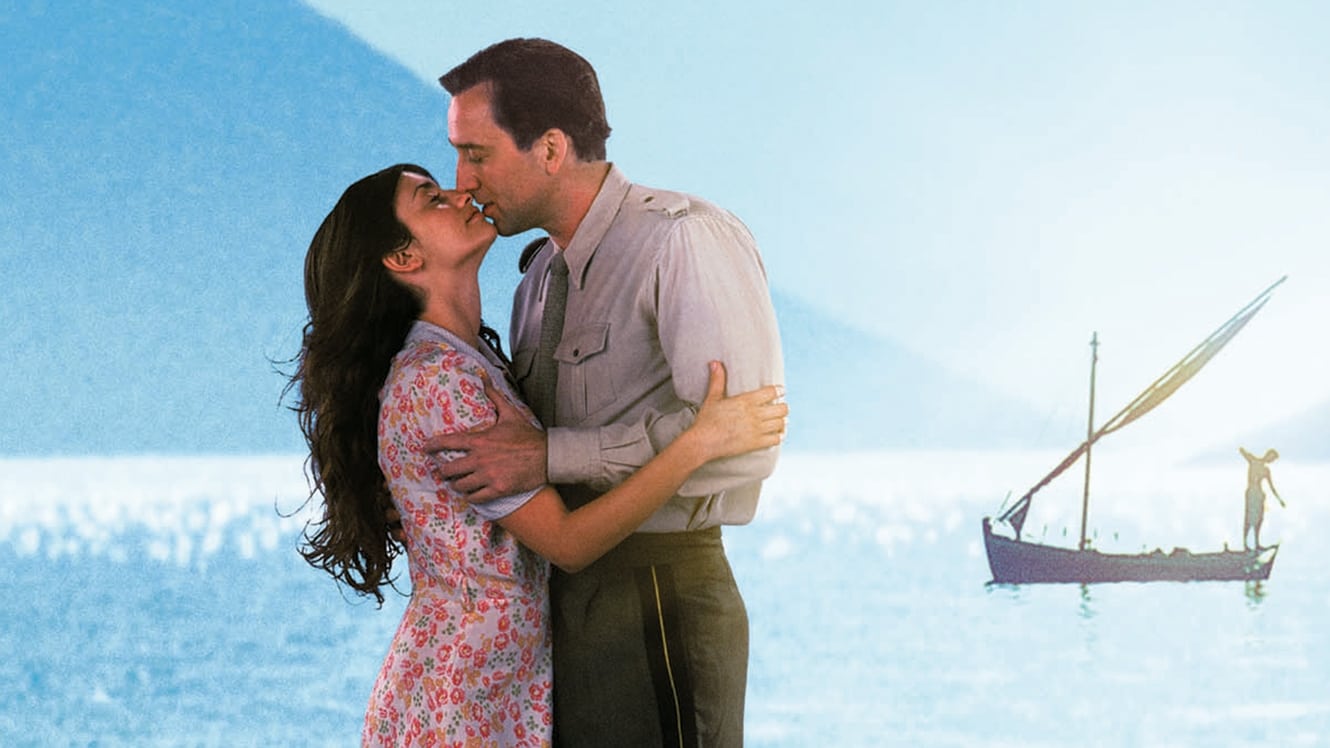
Penelope Cruz is an actress who absorbs emotion. She transcends the picture postcard perfection to hint at love’s bitter cruelty. Her eyes question the very idea of happiness, as if somewhere in Pelagia’s soul a dark shadow lurks.
“The history of Cephalonia is earthquakes and slaughter for 2000 years,” the doctor says. She carries this knowledge inside her, so that when disaster strikes, she is protected.
Excitement is a long time coming, but when it does, debris scatters across Eden.