Helen Mirren and Julie Walters’ Feel-Good British Classic Was Inspired by a Remarkable True Story
TRAILER BELOW
Long before feel-good dramas about ordinary people doing extraordinary things became streaming favorites, Helen Mirren and Julie Walters starred in a British comedy that turned an unlikely real-life fundraising idea into an international phenomenon.
Released in 2003, Calendar Girls follows a group of middle-aged women from a quiet Yorkshire community who decide to raise money for charity after one of them suffers a devastating personal loss.
Their plan begins innocently enough.
Then somebody suggests making a calendar.
The problem is that this will be nothing like the traditional Women’s Institute calendar anyone is expecting.
A Personal Loss Inspires an Unusual Idea

Mirren plays Chris Harper, while Walters stars as her close friend Annie Clarke.
When Annie’s husband John dies from leukemia, the women want to raise money for the local hospital in his memory. Their initial ambition is modest: they hope to help purchase a new sofa for the relatives’ waiting area.
Chris eventually comes up with a much bolder way of raising the money.
She persuades several women from their local Women’s Institute group to pose for a calendar wearing considerably less than anyone in their conservative community might expect — while strategically using everyday objects such as flowers, baked goods and household items to preserve their modesty.
It is an idea that initially sounds almost impossible to pull off.
But once the calendar appears, the reaction becomes far bigger than the women imagined.
Based on the Women Who Really Did It

The film was inspired by members of the Rylstone and District Women’s Institute in North Yorkshire.
The real women created an alternative calendar to raise money for leukemia research following the death of Angela Baker’s husband, John, from non-Hodgkin lymphoma.
What began as a local fundraising effort attracted enormous attention, eventually becoming a worldwide story.
Calendar Girls takes that extraordinary premise and builds a warm comedy around friendship, grief and what happens when a group of seemingly ordinary women suddenly find themselves in the public eye.
Rather than presenting its characters as glamorous models, the movie makes their age and everyday lives central to the story.
That becomes part of its appeal.
Helen Mirren and Julie Walters Lead a Familiar British Cast
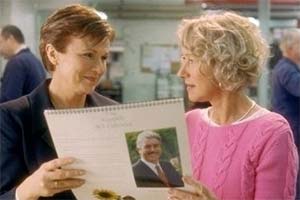
Mirren and Walters are joined by an impressive ensemble including Celia Imrie, Penelope Wilton, Annette Crosbie and Linda Bassett.
Directed by Nigel Cole, the film balances its more outrageous comic moments with the sadness that inspired the calendar in the first place.
Mirren’s Chris is energetic and determined, pushing the project forward when others hesitate, while Walters gives Annie a quieter emotional center as she continues grieving for her husband.
Their friendship becomes increasingly important once their little Yorkshire fundraiser grows beyond anything either woman anticipated.
Because success brings its own complications.
The attention surrounding the calendar begins changing relationships within the group, particularly when publicity takes the women far beyond their familiar community.
A Small British Story Became an International Success
Calendar Girls proved that its unusual premise could connect with audiences well beyond Yorkshire.
The film became a box-office success and helped turn the story of the real Calendar Girls into something recognized around the world.
But beneath the cheeky premise is a surprisingly emotional story.
The women are not simply trying to shock their neighbors. Their decision grows from grief and a desire to create something meaningful from a painful loss.
That contrast — between the playful calendar and the reason it exists — gives the film much of its warmth.
More Than Two Decades Later, Its Message Still Works

Calendar Girls arrived in cinemas more than 20 years ago, but its central idea has aged remarkably well.
Its heroines are women who would rarely have been treated as conventional movie leads, particularly in a story involving confidence and body image. Yet the film never asks them to become younger or transform themselves before stepping in front of the camera.
Instead, the joke is partly on everyone who underestimated them.
There are laughs, embarrassment and plenty of raised eyebrows, but the movie ultimately remains a story about friendship and women refusing to disappear simply because they have reached middle age.
And perhaps that explains why Calendar Girls still feels so distinctly charming today.
What begins with a group of Yorkshire women hoping to buy something as ordinary as a hospital sofa ultimately becomes a story that travels around the world — all because they were willing to make one very unconventional calendar.